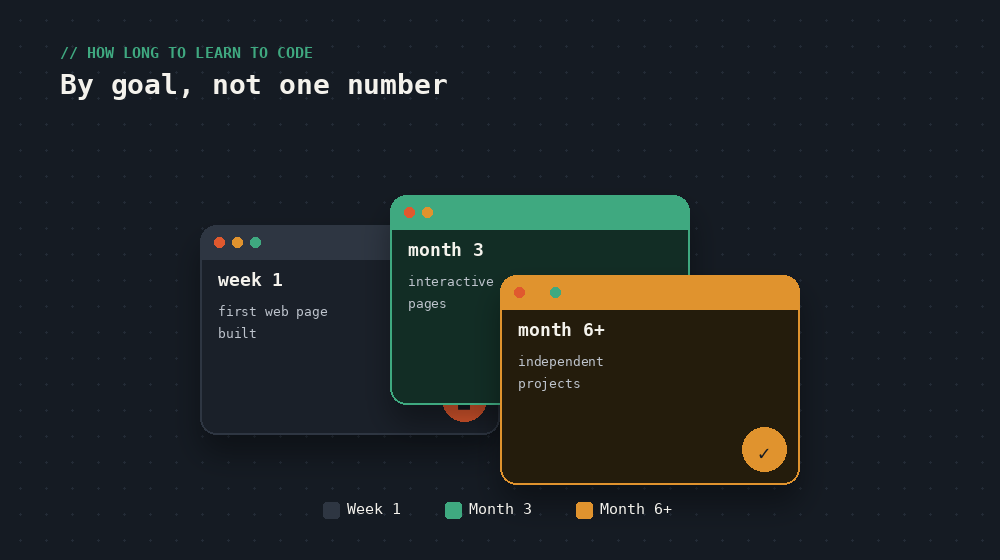
It depends on the target, not just "learning to code"
| Goal | Realistic timeline |
|---|---|
| Build a simple static web page from scratch | 1-2 weeks of consistent practice |
| Build an interactive page with JavaScript | 1-3 months |
| Comfortable building small personal projects independently | 3-6 months |
| Job-ready for an entry-level developer role | 6-12 months, often longer |
These ranges assume regular, consistent practice — a few hours several times a week — not sporadic bursts once a month.
Why "how many hours" is the wrong question
Two people can log the same 100 hours and land in very different places, because consistency matters more than raw total time. Thirty minutes a day for two months beats ten hours in one weekend, then nothing for a month — the second approach means constantly re-learning what you forgot instead of building on it.
The uneven pace of actually learning
Progress rarely feels linear. Expect stretches where nothing seems to click, followed by a jump where several previously confusing things suddenly make sense together. This is completely normal — it doesn't mean the slow stretch was wasted time.
What actually speeds this up
- Building, not just watching — passively following tutorials teaches recognition, not the ability to build independently
- Consistency over intensity — regular short sessions beat occasional long ones
- Finishing small projects — a completed simple project teaches more than an abandoned ambitious one
- Getting comfortable with being stuck — the ability to sit with a confusing bug without panicking is itself a skill that improves with practice
A realistic first milestone
Rather than aiming at a vague "learn to code," aim at something concrete and achievable soon: build one complete, working page using HTML, CSS, and a little JavaScript — like the final project in our HTML & CSS Fundamentals course. Having one finished thing, even simple, does more for motivation than an open-ended goal with no clear finish line.
Reading about it is step one. The devnotes courses are where you actually build it — hands-on, one short lesson at a time.