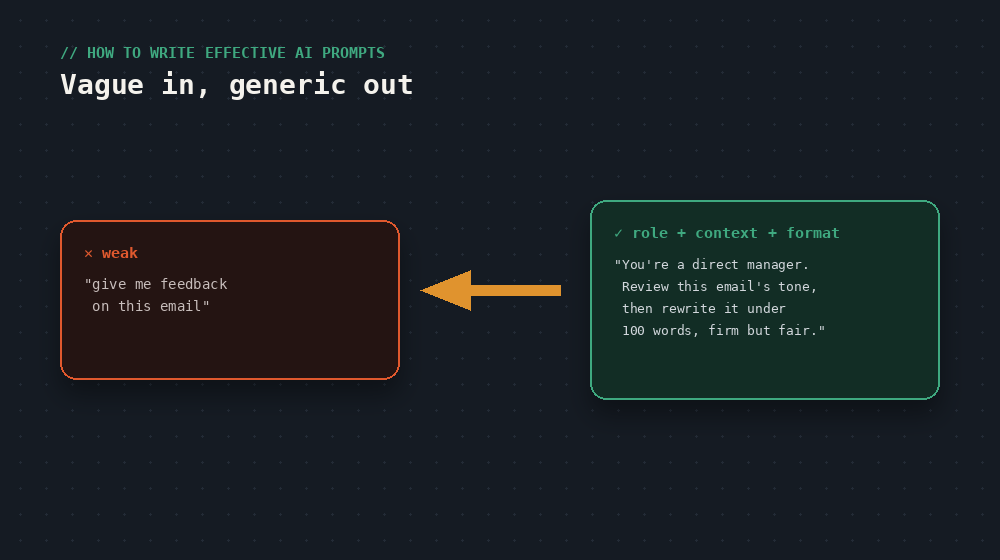
Vague prompts get vague answers
"Write a blog post about productivity" and "write a practical blog post for overwhelmed freelancers about cutting task-switching, using two simple systems they can start today" ask for the same general thing — but only one of them tells the AI enough to actually be useful. The AI isn't guessing what you meant; it's filling gaps you left open, usually with the most generic, average version of an answer.
The four things worth stating explicitly
| Element | What it answers |
|---|---|
| Role | Who should the AI act as? ("You're a senior copywriter," "act as a strict code reviewer") |
| Context | What's the situation? Who's the audience, what's already been tried, what constraints exist? |
| Task | The specific action, stated as a clear instruction, not a topic |
| Format | How should the output look? Length, structure, tone, bullet points vs. prose |
You don't need all four in every single prompt — but for anything that matters, filling in at least role, context, and format turns a generic answer into something close to usable on the first try.
See the difference in practice
The second version doesn't just ask for "feedback" — it defines the lens to give feedback through, the stakes, and exactly what a good output looks like.
Give it examples when the format matters
If you have a specific style or structure in mind, showing one or two examples ("few-shot prompting") almost always beats describing it in words. AI is far better at matching a pattern you show it than following an abstract description of that pattern.
Ask it to think in steps for anything complex
For reasoning-heavy tasks — debugging, math, multi-part decisions — explicitly asking the AI to work through the problem step by step before giving a final answer noticeably improves accuracy. It's the difference between asking for a conclusion and asking for the reasoning that leads there.
Treat the first response as a draft, not the answer
The people who get consistently good results rarely accept the first output. They read it, then respond with something like "make this more concise," "the tone is too formal, loosen it up," or "this misses X — redo it accounting for that." Iterating two or three times, in the same conversation, almost always beats trying to write one perfect prompt from scratch.
Build a small library of prompts that already work
Once you find a phrasing that reliably gets a good result for something you do often — summarizing meeting notes, drafting outreach messages, reviewing code — save it. Reuse and tweak it instead of starting from scratch every time. This is exactly how the lessons and prompt examples throughout our other AI articles were built: not one perfect prompt, but a small set of reliable ones, reused deliberately.
Sources referenced in this article
Reading about it is step one. The devnotes courses are where you actually build it — hands-on, one short lesson at a time.